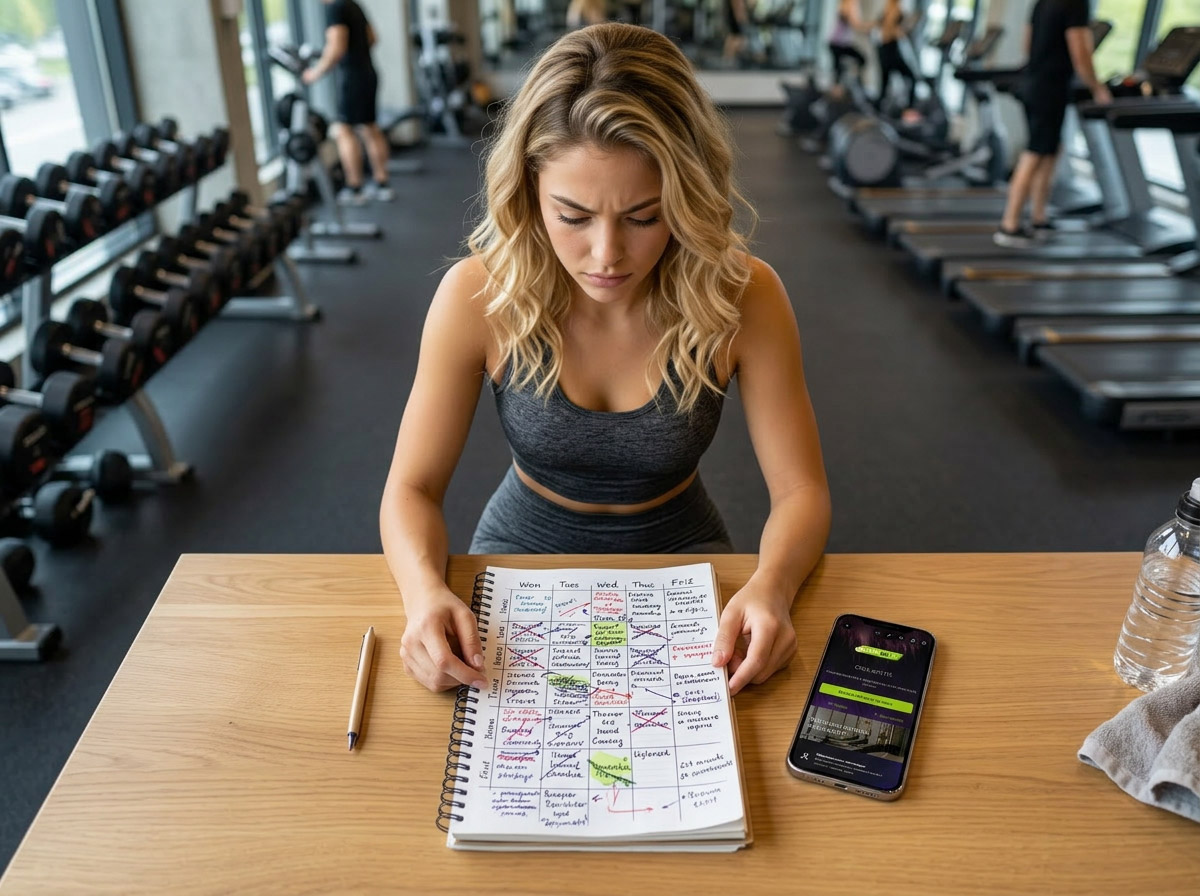
From Notebook to Software: When It's Time to Digitize Your Business
If you still manage your class schedule in a notebook, an Excel sheet, or an endless chain of messages in Viber and Messenger, you’re not alone. Most trainers and owners of small fitness and yoga studios start exactly that way. The problem is not the notebook itself. The problem is that it works perfectly while the business is small — and stops working the moment the business starts to grow.
The question is not whether you should digitize, but when. Here are a few signals that show the moment has already arrived.
7 signs your notebook has stopped working for you
- Double bookings happen. Two clients show up for the same spot at 6:00 PM on Monday. No one is to blame — it’s simply hard to track real-time availability manually, especially if you’re taking bookings by phone, on Instagram, and in person at the same time.
- You spend more time confirming bookings than coaching. Every evening, you message every client with “confirming for tomorrow at 9:00” instead of using that time to prepare sessions or rest.
- You don’t really know your numbers. How full is the Monday 6:00 PM class compared to Wednesday 6:00 PM? How many clients did you lose this month? Without that data, your decisions are based on gut feeling, not facts.
- You don’t know which clients have gone quiet. A client who came regularly for 3 months and suddenly stops showing up can easily get lost in a notebook. And those are exactly the people who are easiest to win back — if you notice in time.
- You’re growing, and coordination is turning into chaos. A new instructor, a second studio room, more weekly sessions — the manual system that worked for one person in one location breaks quickly once you start scaling.
- Your clients ask, “Do you have online booking?” Younger audiences especially expect to book a class at 11:00 PM from their phone without waiting for you to reply to a message the next morning.
- Every month, you prepare reports and invoices by hand. Revenue, attendance, instructor commissions — everything gets collected in a separate spreadsheet instead of coming automatically from the system you already use to run the business.
If you recognize yourself in at least two or three of these points, you are probably already losing time and money without fully realizing it — simply because the chaos has built up gradually.
There is also an eighth, quieter sign: the feeling that the business depends entirely on you. If you go away for two days and nobody else can check who is booked for tomorrow’s class, that is not a sign of strong organization — it is a sign that your system exists only in your head and in a notebook that can be lost, soaked in coffee, or simply left at home on the day you need it most.
A quick calculation: what chaos actually costs
Let’s take a typical small studio with 14 classes per week (2 per day) — a normal volume for an independent trainer or an early-stage studio. Two of the problems caused by manual management have a direct and easily measurable financial cost.
First, duplicate bookings. When you take reservations at the same time in a notebook, over the phone, and via Instagram messages, sooner or later two clients show up for the same spot. A system with one unified, real-time schedule makes that physically impossible — the spot simply disappears from availability the moment it is taken.
Second — and more important for revenue — the waiting list. When a client cancels at the last moment, it is rarely possible to notice in time and offer the place to the next interested person manually, so the spot just stays empty. With a system where waiting clients are notified automatically as soon as a place opens up, it is realistic to fill at least one extra spot per class that would otherwise go unused.
With 14 classes per week, that means 14 extra bookings every week, generated solely thanks to the waiting list. At an average price of 5 to 10 euros per session, that adds up to between 70 and 140 euros in extra weekly revenue — or roughly 150 to 300 euros per month (rounded down, because not every class will actually have a waiting list).
For a business of this size (around 60 classes per month), a subscription plan in the range of 20 euros per month is usually more than enough. In other words, the math is simple and immediately visible: you pay around 20 euros per month, and from spots filled via the waiting list alone, you gain between 150 and 300 euros on top. The time saved and the calmer day-to-day organization come as a bonus on top of that.
What you actually gain from digitization
Digitization is not an end in itself, and it is not a “nice modern extra.” It solves specific problems:
- Time saved. Automatic confirmations and reminders handle the communication you would otherwise do manually every evening.
- A better customer experience. A link or QR code that lets clients book in 30 seconds is far more convenient than sending a message and waiting for a reply.
- Data for better decisions. You can see which time slots are full, which are empty, and which clients generate the most revenue — then adjust your schedule based on reality, not intuition.
- Easy scaling. Adding a new instructor or a second location takes a few clicks instead of reinventing your coordination system every time.
Common fears — and why they usually don’t hold up
“It’s too expensive.” Most platforms for trainers start at a price comparable to one or two sessions per month. The time saved and the reduction in no-shows usually cover the cost within the first few weeks.
“My clients won’t manage an app.” Modern booking systems do not require clients to download anything — a link or QR code that opens a page in their browser is enough. If someone can open Instagram, they can book a class.
“I don’t have time to learn a new system.” Well-designed platforms for trainers are set up in minutes, not days — the key is choosing a system built for people without technical training, not for IT specialists.
What to look for in a booking system
When you are ready to take the step, not every platform is a good fit for a trainer-led business. Pay attention to:
- Your own public booking page, which you can place in your Instagram bio, Google Business Profile, or on a sticker in your window.
- Flexible approval controls — the ability to decide whether reservations are confirmed automatically or reviewed by you first.
- Built-in analytics for attendance, revenue, and occupancy, without needing a separate spreadsheet.
- Automatic reminders for clients and an option to re-engage inactive ones.
- Room to grow — adding instructors, rooms, and locations without changing systems later.
Frequently asked questions
Is the transition from notebook to software difficult? Not if you choose a system designed for trainers rather than IT professionals. Realistically, setup takes between 8 and 15 minutes, and your clients do not notice a “system change” — they simply receive a link they can use to book.
Will I have to enter all my old clients manually? Not necessarily. You can start only with new future reservations and let your client database build itself gradually as people book through the new system.
What happens if I don’t like the software after the trial period? Most platforms, including Click and Fit, offer a free trial for exactly that reason — so you can test everything without commitment before paying anything.
Will I lose the personal connection with my clients? No — digitization automates the administrative part (confirmations, reminders, reports), not the coaching itself. In practice, it gives you more time for your clients, not less.
The right moment is now, not when you’re overwhelmed
The best time to digitize your business is before the chaos, not after it. If you wait for the “perfect moment,” when you supposedly have more free time, it usually never comes on its own — because manual management is exactly what consumes that time.
If you decide to try it, platforms like Click and Fit offer a free 30-day trial — enough time to see the difference without any risk. In the next article, we will look at how you can set up a business profile and start accepting your first reservation in literally 8 minutes.